
Where the Pod Went
The pod didn't shrink to one consistent size. It dispersed — and the coordination cost moved with it.

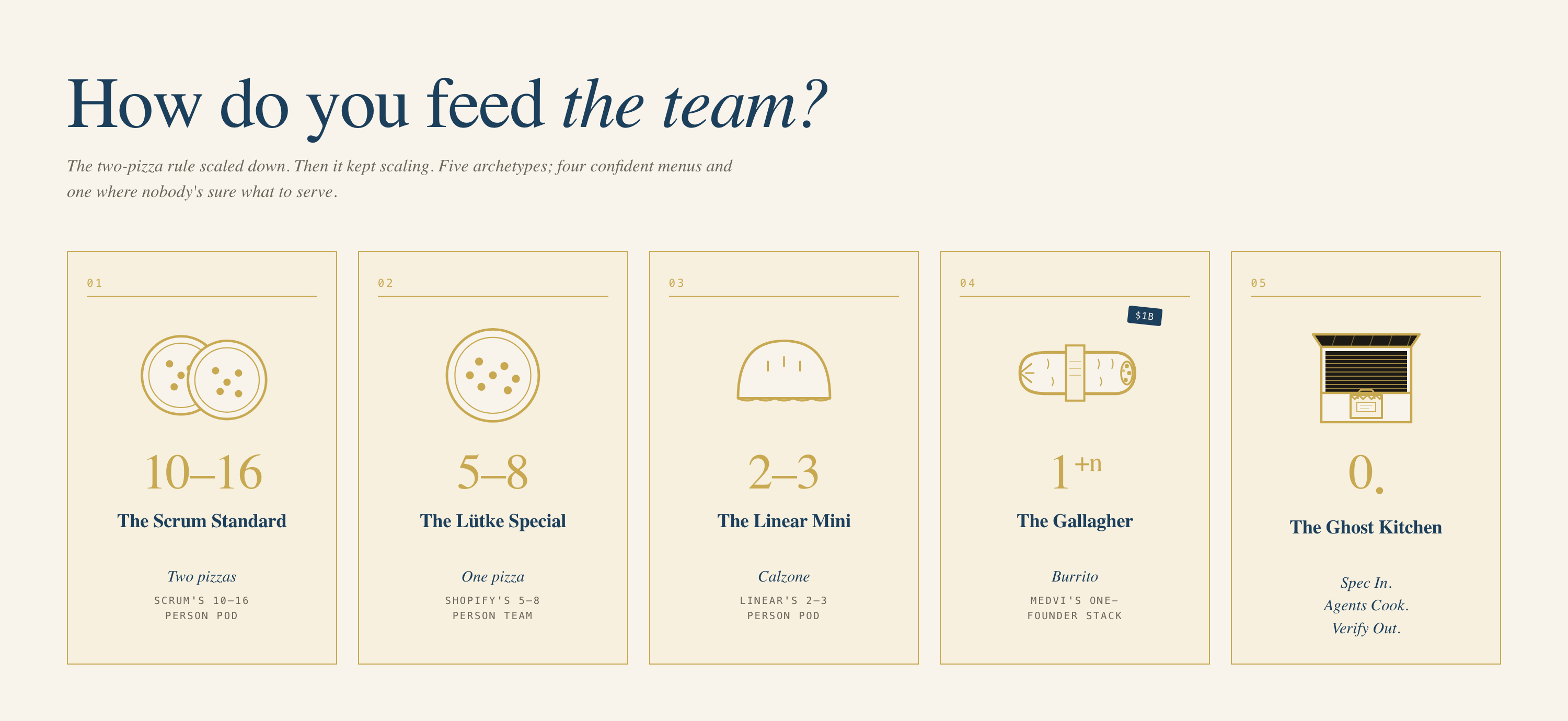
Andrew Carlson · July 2026
In March 2026, Atlassian cut 1,600 employees, more than nine hundred of them from R&D, and split its CTO role into two AI-focused positions. Two months later, GitLab doubled its R&D team count from roughly thirty to sixty and cut three layers of management. A few months earlier, Shopify’s CEO told a podcast audience that his company prefers five-person teams and goes up to eight when it must. Across these announcements and dozens more, a structural change is visible: the pod that ran software for two decades is being unbundled.
Waterfall gave way to Agile in many forms (Scrum, SAFe, the Spotify model) that converged on the same artifacts and ceremonies: two-week sprints, scale by adding more pods. The Scrum manuals prescribed five to nine people per pod; the actual practice drifted toward ten to sixteen. For twenty years, every software product organization chasing the SaaS growth model landed somewhere on that curve.
What’s emerging now has no equivalent equilibrium. Fifty-person companies operate as a single pod. Five-person teams run their own agent swarms. Two-person teams run their own agent swarms. Harnesses and agents are everywhere. The coordination layer between teams that Agile spent two decades formalizing has not been replaced. The story being told about all this is that pods got smaller. That is the smaller half.
What replaced the pod
The post-February evidence doesn’t show a replacement. It shows a dispersion. The Tiny Teams Playbook, echoed independently in recent months by Karpathy, Mollick, Jack Clark, and Marco Kotrotsos, talks as though one new equilibrium has arrived. The evidence below says otherwise.
At the small end, Cursor’s operating pattern is the archetype: engineers own features end-to-end with their own agent fleets, no product managers, no formal pods. The pod is one person plus their agents; the company is the sum of those individual dispersions. Cursor scaled to roughly 300 people by mid-2026 (up from around 50 earlier this year), and the individual-ownership pattern held through the growth. Lovable looks similar. So does General Intelligence Company, which launched in February explicitly framing its engineers as tech leads and its agents as ICs.
A step up, Linear’s Karri Saarinen has described his squad model since 2023, confirmed for the 120-person 2026 version: one designer plus two engineers per squad, six squads in parallel. OpenAI’s Codex team (per practitioner-reported disclosures, not corporate statements) runs sub-pods of two to three people inside a roughly forty-person product organization, with a PM-to-engineer ratio near one to thirty-seven. Neither is aspirational. They are the standing shape of work at companies most identified with the frontier.
Shopify is the only clean enterprise-scale disclosure. Tobi Lütke in January: “Shopify loves the five-person team. We increase to eight sometimes.” Roughly 3,500 people in R&D, organized into “lots and lots of small teams.” If a Fortune 500 software company has a formal pod-size policy on the record, this is it.
Then there’s Cognition, whose fifteen-human, five-Devin-per-human ratio from May 2025 remains, over a year later, the most-cited structural number in the discourse. Peter Steinberger has described running three humans on roughly one hundred Codex instances for a specific OSS project. That is a usage configuration, not a standing pod, but it shows where supervision ratios are climbing.
The legacy ten-to-sixteen pod isn’t gone. JetBrains’ 2025 survey of 24,534 developers still has half of all teams between two and seven people, and 88% under twenty. The cluster moved before AI agents arrived. What changed since last year isn’t the direction. It is the speed and the dispersion. Solo plus agents is one model. Project squads of two to five is another. Shopify’s five-to-eight is a third. Cognition’s fifteen-with-fleets is a fourth. Where you sit depends on what you build, not on what your competitor does.
Where the human sits now
The dispersion has a second axis the pod-size discussion under-names: not just how many humans are on the team, but where in the work they sit.
Dark factories in manufacturing run with the lights off: automated lines, no humans on the floor, just specification at the front end and verification at the back. At the frontier, software development is moving toward a version of that shape, unevenly. Engineers at Cursor write the spec, dispatch an agent fleet, and resume at the review step. Anthropic’s Cowork sprint, four engineers building a Claude Code for non-coders project across ten days, used the same shape: humans at direction and verification, Claude Code generating the code in between. v0 and Lovable’s solo builders describe the same pattern. General Intelligence Company explicitly framed its February launch as engineers-as-tech-leads, agents-as-ICs.
This is not just about smaller teams. A two-person Linear squad still works the old way: people at the keyboards through the cycle. A solo Cursor engineer with an agent fleet does not. Headcount and orientation are independent variables. The same five-person team can run two completely different operating shapes depending on where the humans sit in the work.
The bottleneck moved
Both axes have a cost the practitioner conversation has not internalized.
Faros Analytics published an “AI Productivity Paradox” report earlier this year covering 22,000 developers across 4,000 teams. The dataset is vendor-produced rather than peer-reviewed, so the magnitudes deserve hedging, but the directional pattern is striking. Among teams moving from low to high AI adoption, Faros reports a 98% increase in pull requests merged per developer and a 66% increase in epics delivered per developer. Those numbers are real. They are also half the table.
The same cohort showed a 242.7% increase in the incidents-to-PR ratio, an average 91% increase in code review time, and a 154% increase in average PR size. The net effect at the company level: no statistically significant improvement in velocity. Engineers were measurably faster. Companies were not.
This finding is no longer one company’s data. Sinan Aral and Harang Ju at MIT ran a field experiment with 2,234 participants in March 2025, revised this February. Human-AI teams produced 50% more output per worker than human-human teams. They also exchanged 18% fewer interpersonal messages. Workers performed 62% fewer direct edits. A thirteen-month study of three agile teams at a large consulting firm found sharp increases in performance and perceived efficiency concurrent with flat developer activity. Value density rises. Volume is flat.
The mechanism has a name now. Margaret-Anne Storey at the University of Victoria published a framework in March extending Ward Cunningham’s technical-debt metaphor. Her paper introduces two new categories. Cognitive debt is the erosion of shared team understanding as AI generates code faster than the team can comprehend it. Intent debt is the absence of externalized rationale that AI and humans both need to work safely. Her summary is six words. We are trading understanding for velocity.
This explains the Faros numbers in a way the practitioner conversation has not. The 91% increase in average review time is not friction. It is cognitive debt accumulating. Reviewers are slower because their shared understanding of the codebase is eroding faster than they can rebuild it. The 154% increase in PR size is the same mechanism: agents produce changes larger than humans can hold in working memory during review. The 242% spike in incidents is the integration cost of merging code the team did not internalize.
The bottleneck moved. It used to live inside the pod, where the constraint was human throughput. It now lives between pods, where the constraint is shared understanding decaying faster than it is replenished. Netanel Eliav names a parallel dynamic for the second axis: the Delegation Feedback Loop. As delegation rises, the supervision capacity needed to run smaller pods erodes — small-pod regimes accumulate adverse effects on long-run capability while generating short-run gains.
The coordination layer is gone
What companies are doing about all this is the harder question. The honest answer is: very little, because the most visible response is to cut the people whose job was to handle it.
Atlassian’s March cut of 1,600 employees, with more than 900 from R&D and the CTO function split into two AI-focused positions, is the structural signal of the year. GitLab’s Act 2 announcement removed up to three layers of management. Block cut 40% of its workforce in late February; the CEO and Sequoia’s Roelof Botha co-authored an essay five weeks later reframing hierarchy as an information-routing protocol replaced by AI. Meta disclosed a 50-to-1 employee-to-manager ratio in Applied AI Engineering, twice the previous outer limit.
The institutional logic predated AI agents by three years. In January 2023, Capital One eliminated 1,100 Agile Coaches and Scrum Masters in a single round. The roles were not redeployed. They were not retitled. They were removed. The Agile coordination layer was being shed before AI made it cheap to do so. What the last six months changed is the speed and breadth of the shedding, not the direction. The 2026 cuts are the same logic, accelerated and generalized across sectors.
The economics behind this is now formal. A working paper by Alex Farach (arXiv:2602.16078, February 17, 2026) models AI as a coordination input that compresses the per-worker cost of supervision: span expands, manager demand falls, and the wage gap between managers and individual contributors widens by a factor of between 5.4 and 10.8 across simulated scenarios. The cuts map onto the model cleanly. Capital One reads like the manager-demand decline. Atlassian’s CTO bifurcation reads like span expansion at the top. Meta’s 50:1 ratio reads like the same compression four levels down. The role that survives at the bottom is the engineer-as-agent-orchestrator. The role that survives at the top is what Botha and Dorsey call the Directly Responsible Individual, a cross-cutting owner who absorbs problems for defined periods. The middle is what’s vanishing.
Rising Tide isn’t the only future
The practitioner conversation is selling one future. The evidence supports at least two.
The future being sold is Rising Tide: low coordination friction, high task creation, contained inequality, broad participation in the gains. This is the regime Garry Tan is selling when he writes about a ten-person, hundred-billion-dollar company. It is the regime Botha and Dorsey are selling when they reframe hierarchy as information-routing. It is the regime the Tiny Teams Playbook implicitly assumes. It is also the regime that requires the displaced coordination layer to find new work in newly created tasks, a labor-market dynamic with no historical guarantee.
The future the cuts actually fit is Winner Takes All: high coordination friction, low new-task creation, sharp inequality, modest absorption of displaced workers. Capital One eliminated the coordinator role outright. Atlassian cut 1,600 with no compensating role rebuild. Block cut 40% of its workforce. Under Farach’s criteria, none of these reads like Rising Tide. Under Farach’s criteria, all of them read more consistently as Winner Takes All. The wage dispersion Farach formalizes, the manager-IC gap widening by 5.4× to 10.8×, is the distributional signature of that regime, and it is happening in the field.
Cursor’s ARR-per-employee ratio (roughly $13M per person at ~300 total employees — not just engineers — in mid-2026, up from an estimated $40M per engineer at ~50 people earlier this year as the case became canonical) and Cognition’s fleet compressions are a different regime again, closer to creative destruction, where new task frontiers are opening fast enough to absorb labor but only at the upper end. SpaceX’s $60 billion all-stock acquisition of Cursor (announced June 2026, expected to close in Q3) complicates the read. It can be interpreted as creative destruction accelerating — the fastest ARR ramp in business software history reaches the largest venture-backed acquisition ever — or as Winner Takes All resolving — a Musk holding absorbs the archetype AI-native company; founders receive SpaceX shares, not independent equity. Both readings fit. The same technology is producing different regimes simultaneously in different companies and sectors, and the discourse is averaging them into a single narrative that fits none of them well.
The single-number debate is unanswerable
We are mid-restructuring, not at a new equilibrium. The operating question for a senior leader making pod-design decisions in 2026 is not “how small should our pods get.” It is two questions.
The first question is where in the dispersion the organization actually sits. Are we Cursor-shaped, where each engineer is the pod? Are we Linear-shaped, with two-to-three person squads? Are we Shopify-shaped, with five-to-eight? Are we still ten-to-sixteen because nothing has been restructured? Each is a defensible answer for the right kind of work. None is the right answer in general. The single-number debate is unanswerable; the where-do-we-sit debate is answerable, and the data is finally good enough to answer it.
The second question is which regime the organization is heading into, and whether that is the regime the leader wants. Pod-shrinkage and regime are not the same question. A team can shrink while the organization heads into Winner Takes All, with rewards concentrating at the top and the middle layer eliminated rather than redeployed. A team can shrink while the organization heads into Rising Tide, with new task frontiers opening and the displaced layer absorbed into new roles. The mechanics produce the first by default. The second requires design.
Two operating recommendations follow. The first is to stop picking a pod size because a competitor or a venture firm has picked one. The dispersion is real, and the right shape depends on the work. Cursor’s flat-at-scale structure, Linear’s squad of three, Shopify’s five-to-eight, and Cognition’s fifteen-with-fleets are all defensible for what those companies build. Before picking a size, decide where your humans will sit in the cycle; the same five-person team can run two completely different operating shapes. Pick for what you ship. The second is to measure cross-pod coordination cost before celebrating per-pod throughput. If your dashboard shows pull requests merged but not review-time inflation, incident rates, and the loss of shared codebase understanding, your dashboard is showing you half the table.
Somewhere in your organization, a senior leader is making a pod-shrinkage argument by citing the Tiny Teams Playbook without engaging the coordination-cost literature. That is the readership this essay is for. The honest answer to “how big should the pod be” is the one the data supports: smaller than ten, probably larger than two for coordination-intensive work, distributed enough that there is no single right answer, with the human position in the work as important as the headcount.
The pod is not dead. It is dispersing. What’s dead is the assumption that the question has one answer.
The Gallagher, on the hero image, refers to Matthew Gallagher’s Medvi — the closest real-world claim yet on Sam Altman’s “one-person billion-dollar company” bet.
End